
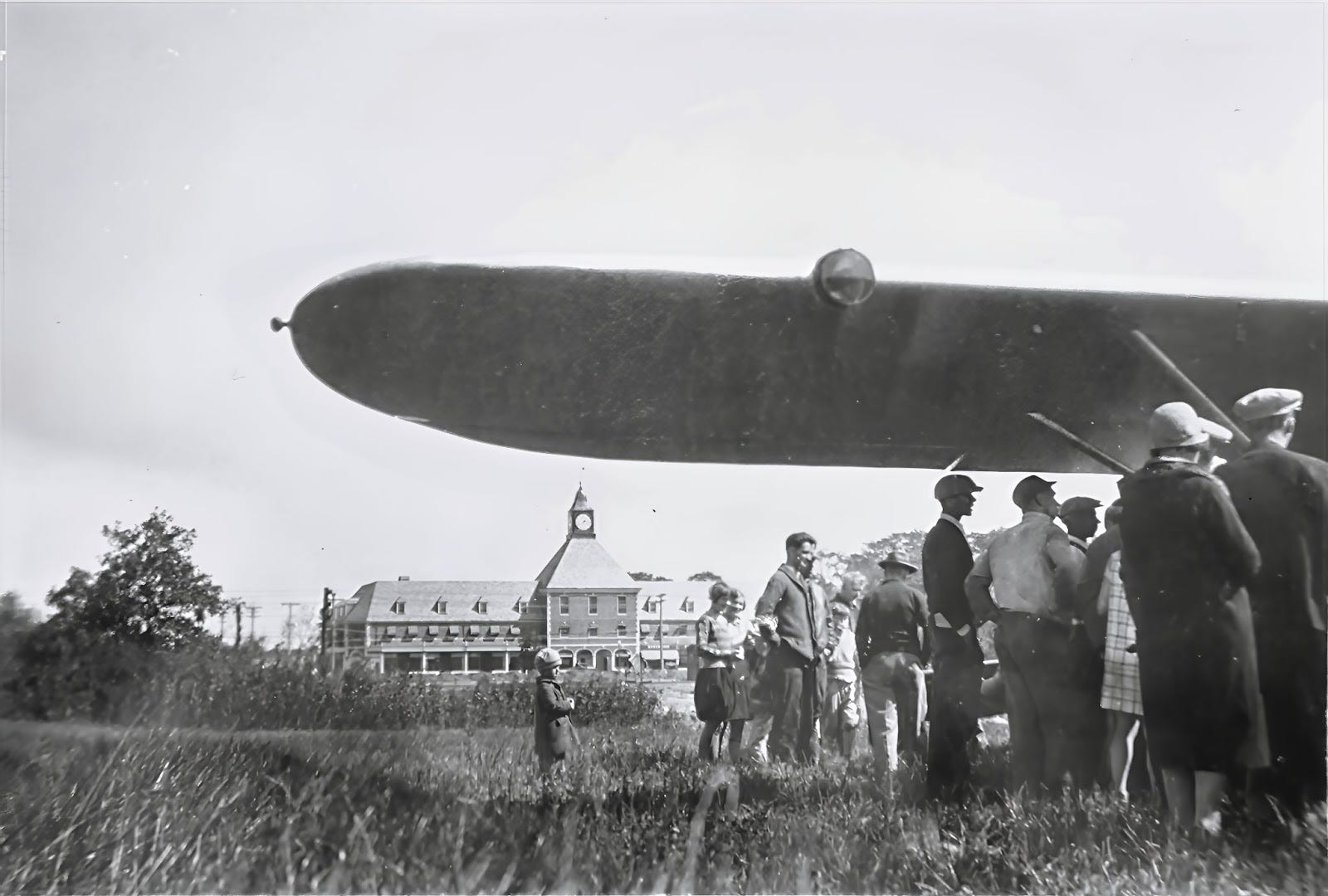
This story begins with a striking, never-before published photograph that we found in the papers of Marjorie Sewell Cautley, Radburn’s landscape architect, at the University of Pennsylvania.
The image, probably taken by Cautley, depicts a Radburn scene in 1929, the community’s first year. In a field west of the Erie Railroad tracks, a crowd has gathered, attracted by a biplane sitting on the grass. The plane’s upper wing stretches across the frame, with its fuselage intriguingly out of view. The Radburn Plaza Building, still under construction, can be seen in the distance.
Why was the plane there? Possibly to shoot aerial photographs of Radburn’s innovative street-and-park plan, which was designed to protect pedestrians from another revolutionary form of transportation – the car.
Whatever the reason, AI (using the image, date and location as inputs) suggests this craft was almost certainly a type of rugged biplane built just a few miles away in Paterson by a now-forgotten company named The New Standard.
The details in the photo – such as the protruding piece on the wingtip (likely a navigation light) and the round light in the middle of the wing – are consistent with New Standard model D-25.
The aircraft was powered by a Wright Aeronautical engine, also built in Paterson. Wright Aeronautical had evolved from the company founded by Orville and Wilbur Wright, who launched humanity into the air in 1903 at Kitty Hawk, North Carolina.
Radburn residents may have had a hand in building the D-25. Census records show that Herbert Ruttom of 322 Plaza Road N worked as an airplane mechanic, and Harry Reich of 9 Brighton Place as an aeronautics moulder.
The D-25 was among the first attempts to build and market an “airborne taxi” for short commuter flights. Its design was relatively simple: Four passengers seated side-by-side in a wide cockpit, with the pilot in the single-seat open rear cockpit.
The plane was also designed for barnstorming. In those days barnstormers put on aerial shows, with stunt flying and wing-walking, that thrilled crowds across the nation. The D-25 also was used to carry mail, dust crops and, during Prohibition, smuggle bootleg liquor.
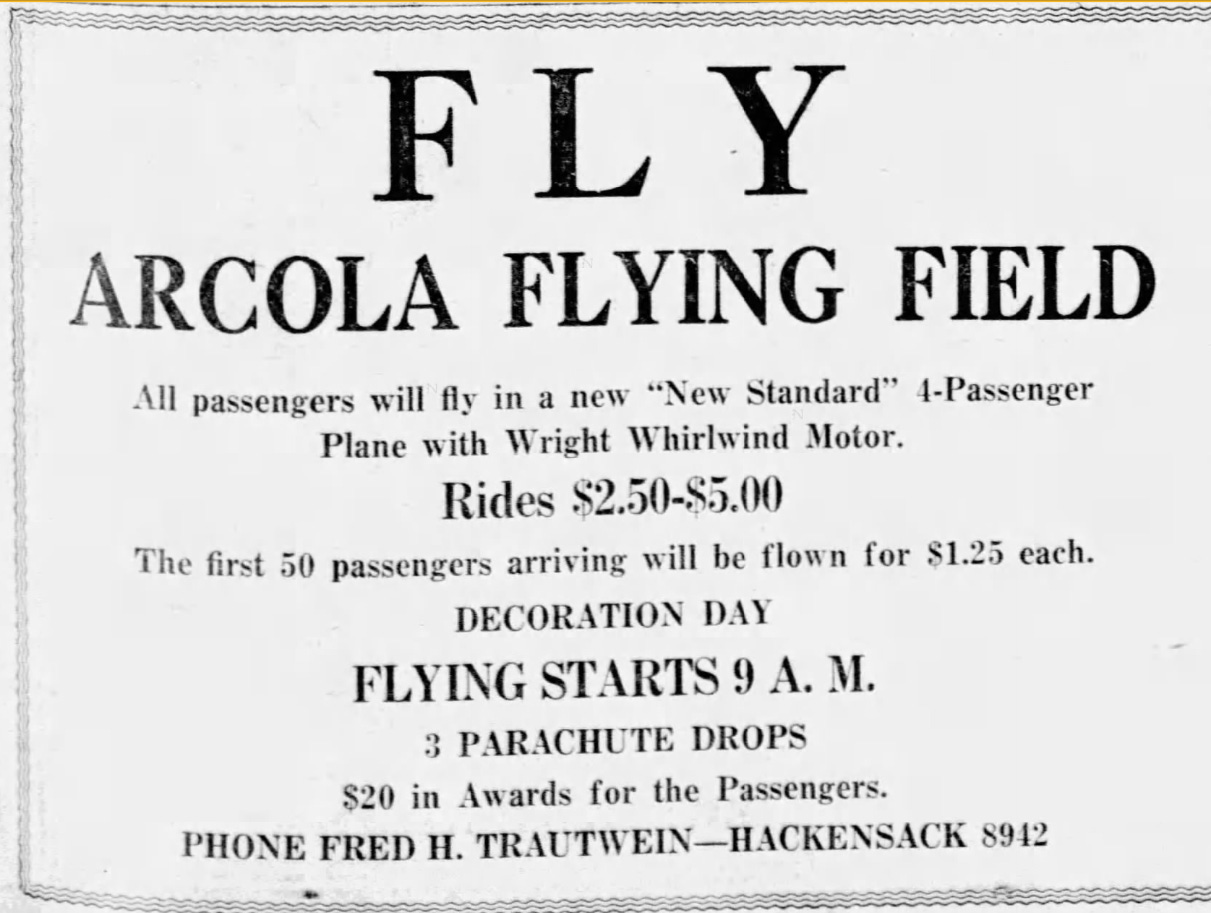
Hackensack Evening Record, May 29, 1930
Some D-25s flew out of the Arcola Flying Field near the southeastern edge of Fair Lawn, which may have been the base for the plane photographed above. Fewer than 100 D-25s were built, but a handful are still flying, nearly a century later.
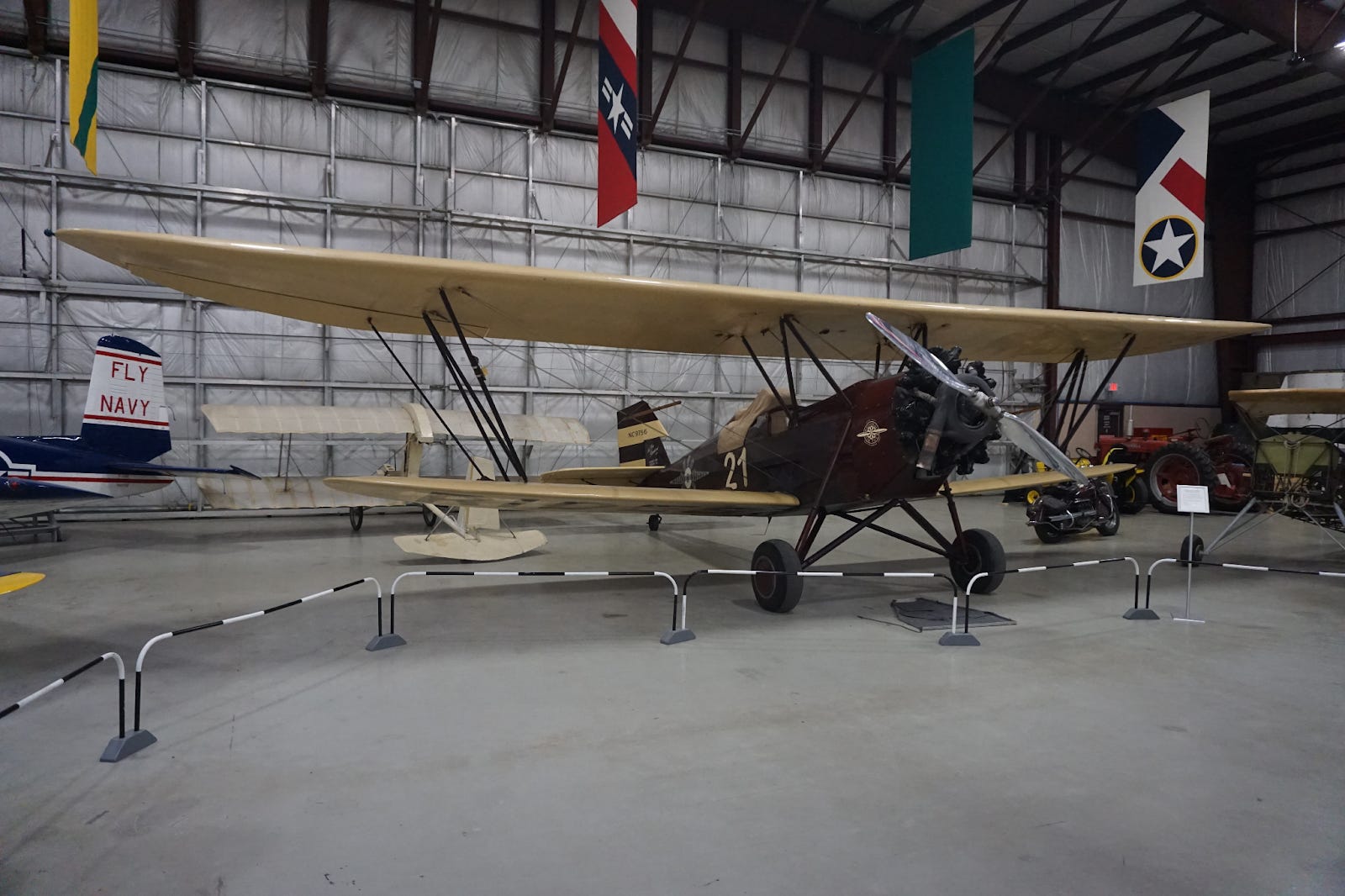
A Standard D-25A on display at the Air Zoo at Kalamazoo/Battle Creek International Airport.
Like Radburn, New Standard Aircraft was first announced in 1928 in Paterson. And like the City Housing Corp., which built Radburn as a model suburb, New Standard had big ambitions and high ideals.
Charles Healy Day, an aviation pioneer who co-founded the company and served as its chief engineer, was interviewed in 1929 by the Paterson Morning Call. He predicted that the airplane would be a force for peace: “It has already brought nations together through its speed, and before many years will unify every nation, which is probably the greatest factor in obviating cataclysms such as the recent World War.’’ In the age of air travel, war between nations would be as inconceivable as war between New York and New Jersey, he added.
But less than a decade later the town of Guernica was bombed by German and Italian planes during the Spanish Civil War, occasioning the greatest anti-war painting of the last century. And in the World War that followed, the destructive potential of the airplane became horrifyingly clear.
At any rate, Day’s commercial dream was doomed. In October 1929 the stock market collapsed, and in 1931 New Standard Aircraft entered receivership. Day resigned as president, and he and his wife left their home in Ridgewood for a round-the-world trip in which they flew over land in a plane he’d built. He worked in aircraft production during World War II and died in 1955.
His partner in New Standard, the famous barnstorming pilot Ivan Gates, sold his share of the company before it went bust. In 1932, after other business failures, Gates jumped to his death from his Manhattan apartment.
City Housing also foundered in the Depression, declaring bankruptcy in 1934 after it had built only a small fraction of its planned “Town for the Motor Age.’’
After World War II, the dream of air travel for the masses was finally realized. But air taxis have yet to become a new standard.
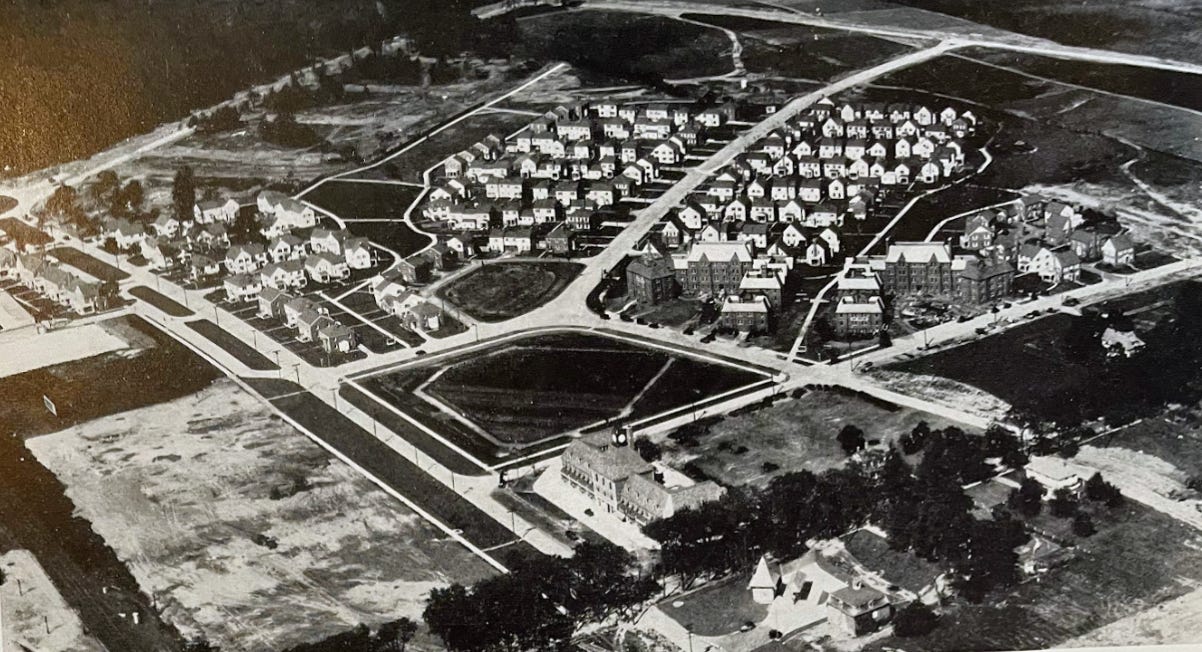
Aerial photograph of Radburn, summer 1929. (Clarence Stein archives)
What’s left to us are two 96-year-old images. One features the D-25’s wing and the curious onlookers, who appear to regard the plane as the future itself. The other is an aerial photo — likely taken that day — that gave the world its first clear picture of what the “Radburn Idea” was all about.
 | A guest post by
|
wow, what a tale! Love how you weave it all together.
Fascinating! Two of my obsessive loves in one post: Radburn and vintage aircraft.