
An old vista returns ... for a while
Demolition clears train station-to-Plaza Building view
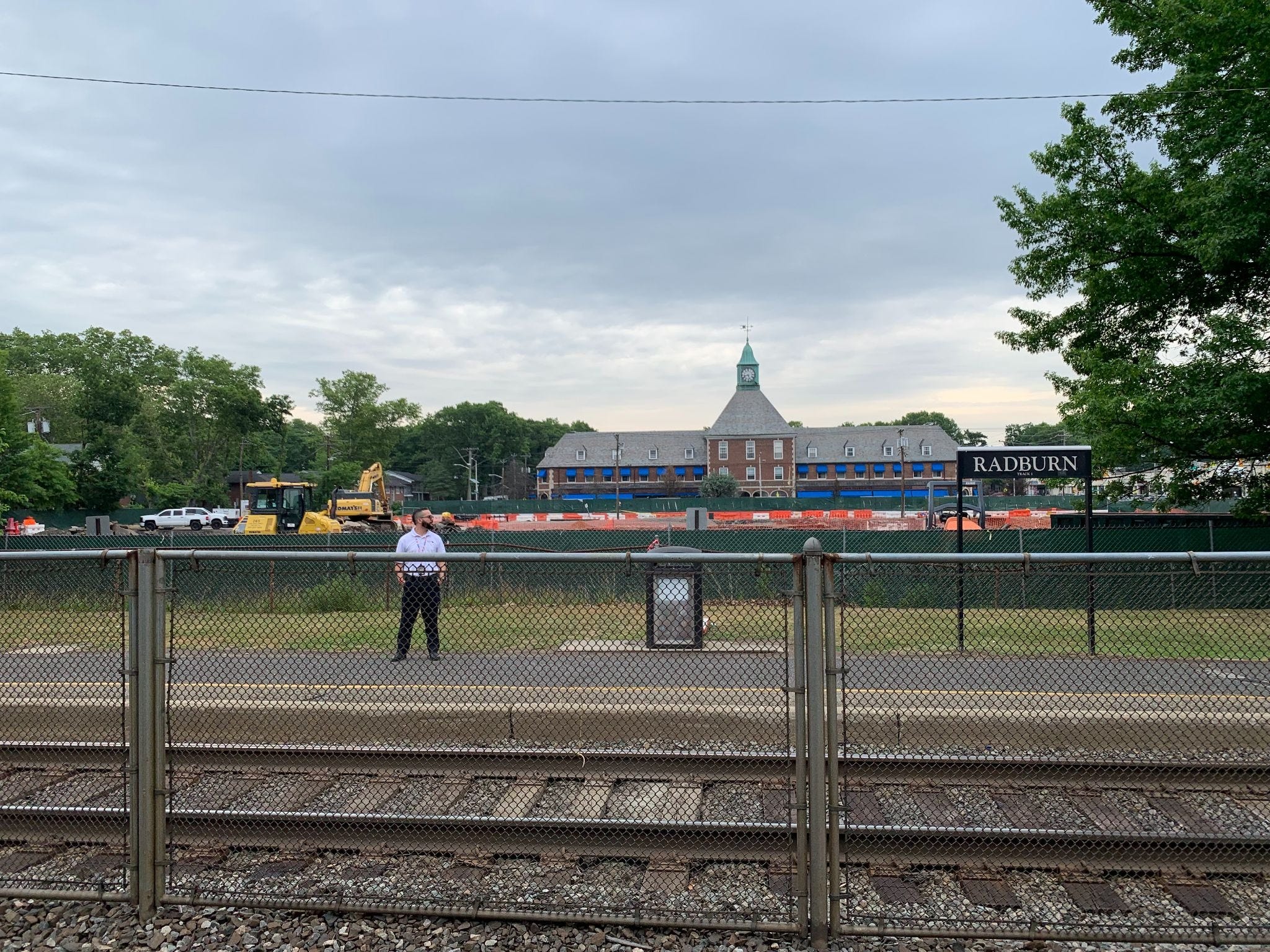
An architectural conversation between two of Radburn’s signature buildings has been revived for the first time in three quarters of a century.
When they were built in the late 1920s, the brick Georgian-colonial Radburn Plaza Building and the stone Dutch-colonial Radburn train station faced each other across an open lot. But around 1950 their view of each other was obscured by the construction of a one- and two-story strip shopping center anchored by a Grand Union supermarket.
The tired old shopping center was demolished earlier this year. That allowed anyone on the train platform the impressive view of the imposing Plaza Building that Radburn’s original planners, Clarence Stein and Henry Wright, intended.
For a few days, the two buildings’ view of each other was almost as good as when they were built. But since then a construction fence, several pieces of large equipment and piles of excavated soil sometimes have gotten in the way.
And when the construction is finished, Plaza Greene – a four-story, mixed-use development with 145 apartments and a Sprouts grocery store – will largely block the two landmarks’ view of each other. People at the train station will see less of the Plaza Building than they did when the shopping center was still there.
A shaded parking lot
In 1927, the City Housing Corporation purchased hundreds of rural acres in Fair Lawn for a model community named Radburn.
According to a design by City Housing’s landscape architect, Marjorie Sewell Cautley, the lot between the train station and the Plaza Building would have become one of the nation’s first parking lots – and maybe the first shaded by trees.
Years later, Cautley set down her reasoning in a planning journal article. Sitting in the sun, she wrote in The American City, “rows of shiny black cars gleam as if fitted with small mirrors.’’ But if parking lots had trees, “the parking space will become a shady, restful grove under which cars will keep cool, instead of blistering their paint and roasting their tired occupants.’’
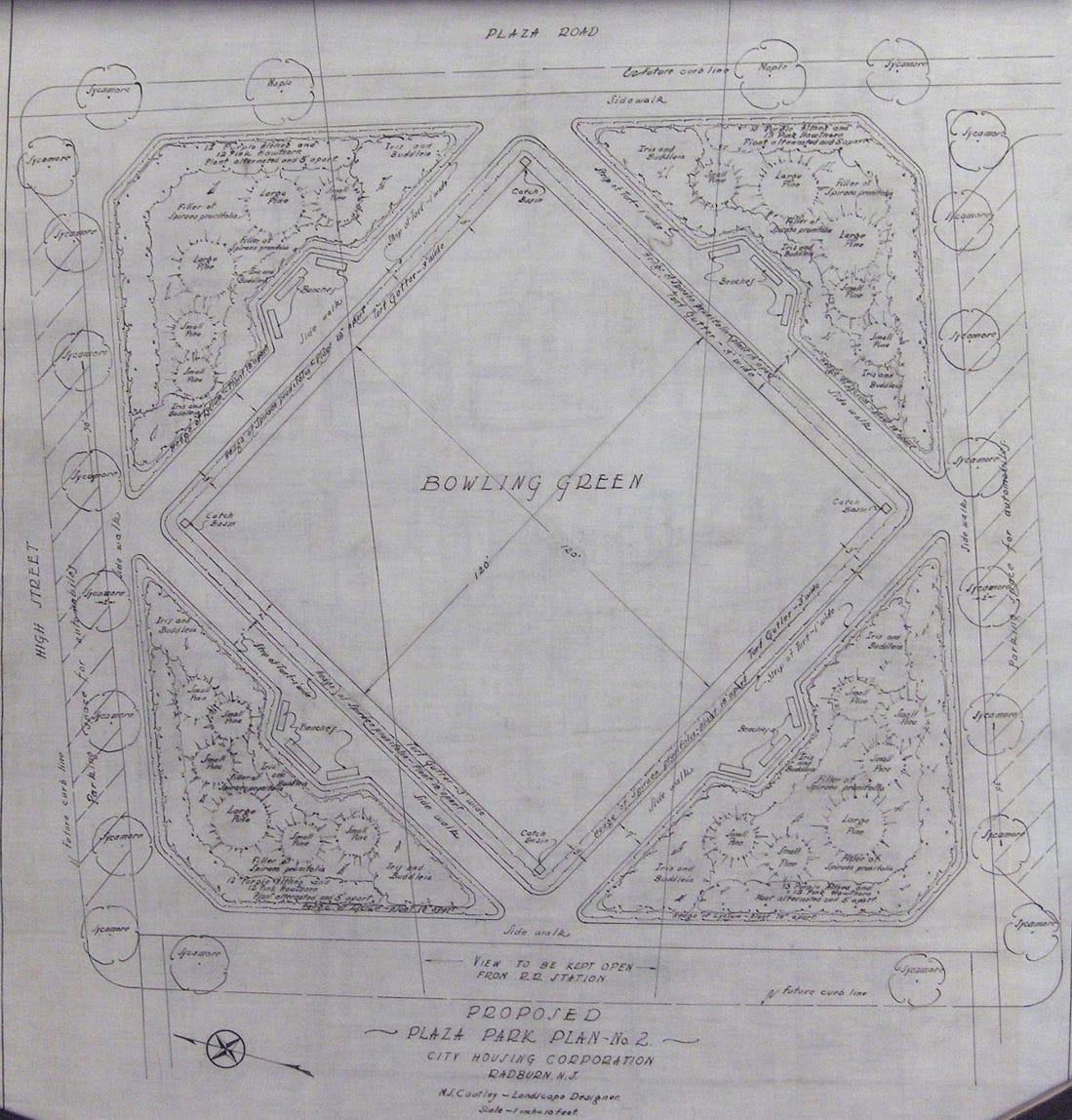
In an alternate plan (“No. 2,’’ above), Cautley envisioned a Plaza Park featuring a lawn labeled “Bowling Green.‘‘ (The term implied a finely trimmed lawn, not necessarily a sports ground.) The square park would have diagonal parking along Fair Lawn Avenue to the south and an extended High Street to the north. Rows of sycamore trees would provide shade, while clusters of pines filled the corners. Cautley indicated on this plan that the view from Radburn Station to the Plaza Building should remain open.
City Housing’s financial woes after the stock market crash of 1929 ended those plans. That’s when the empty lot became grassy Plaza Field – Radburn’s “front yard.’’ It was the site of countless games – softball, football, maybe even cricket (Radburn had a team). Sometimes commuters getting off the train at the end of the day would doff their suit jackets and watch the action – or join it.
In those days, the sight of the Plaza Building and its clock tower told any passenger rolling into Radburn station that they’d arrived at someplace special. That place will always be special – a National Historic Landmark – but with one less great view. A
Love the map you found of Plaza Park with its Bowling Green, oh what might have been? And love the view I've had for over a month sitting at the Train Station and seeing the magnificent Plaza Building with that clock tower, oh how I will miss that, but I love the coming Sprouts Farmers Market with their delicious tomatoes!